Crowding is necessary during transfer, treatment and harvest, but it compresses risk into a short operational window. The 2026 CrowdMonitor report shows that safer decisions depend on combining behaviour, water quality, time and fish condition—not relying on biomass density alone.
The practical takeaway: Treat crowding as a live, time-based operation. Track behaviour above and below the surface alongside water quality, fish condition and operator actions—and use those signals to intervene before welfare deteriorates.
Crowding Atlantic salmon is not simply a question of how many kilograms of fish occupy a cubic metre. It is a live operational process: water volume changes, pumping begins, fish behaviour evolves, oxygen conditions may vary and hazards can develop below the surface even when the water above looks calm.
That is the central lesson from Monitoring and optimising the crowding of Atlantic salmon using health and welfare indicators (CrowdMonitor), a Nofima-led project conducted with the Institute of Marine Research and commercial partners. Its findings point to a practical management principle for fish farmers: steer the operation using several synchronised welfare signals, not one number.
For farm-management systems, the implication is equally important. A crowding record should not be a single density field completed after the event. It should be a time-based operational log that helps staff see deterioration early, act consistently and learn from every crowd. This is where a configurable platform such as KAMAHU’s fish farm management software can provide the structure: linking stock and movement records with tracking sheets, mortality, treatments, sensor data, production reporting and advanced cameras capable of detecting signs of stress.
What the density figures tell us—and what they do not
In controlled tank trials, post-smolts of approximately 530 g were crowded for two hours at four densities corresponding to crowding intensity levels 1 to 4: approximately 100, 130, 180 and 255 kg/m³.
The fish did not show severe behavioural or welfare responses under these experimental conditions, but the data still revealed important changes:
- heart rate increased to about 65 beats per minute during crowding;
- cortisol and magnesium were elevated one hour after crowding, then returned to pre-crowding levels within 24 hours;
- fish at level 1, around 100 kg/m³, grew marginally but significantly better after the event than fish at levels 2 to 4;
- contact between fish was higher at level 4, while activity increased at levels 2 to 4;
- alignment against the water flow became especially marked after 1 to 1.5 hours at levels 3 and 4;
- minor skin changes were still observable 168 hours later.
A second tank trial compared approximately 160 and 320 kg/m³ over one and three hours. It found no major effect of duration or intensity on the measured welfare outcomes, and heart rate rose to about 60 beats per minute during crowding.
These figures need careful interpretation. The tanks were partially drained before fish were crowded sideways with a clam-shell grader, leaving room to move and avoiding forcing fish above the surface. Commercial tank operations often crowd by lowering the water level while pumping fish out. The report explicitly advises caution when generalising the experimental results.
In other words, 320 kg/m³ for three hours is not a general safe limit. The study shows that salmon can sometimes adapt to high density when the environment and method are favourable. It does not show that density or duration can be managed independently of fish condition, water quality, equipment and behaviour.
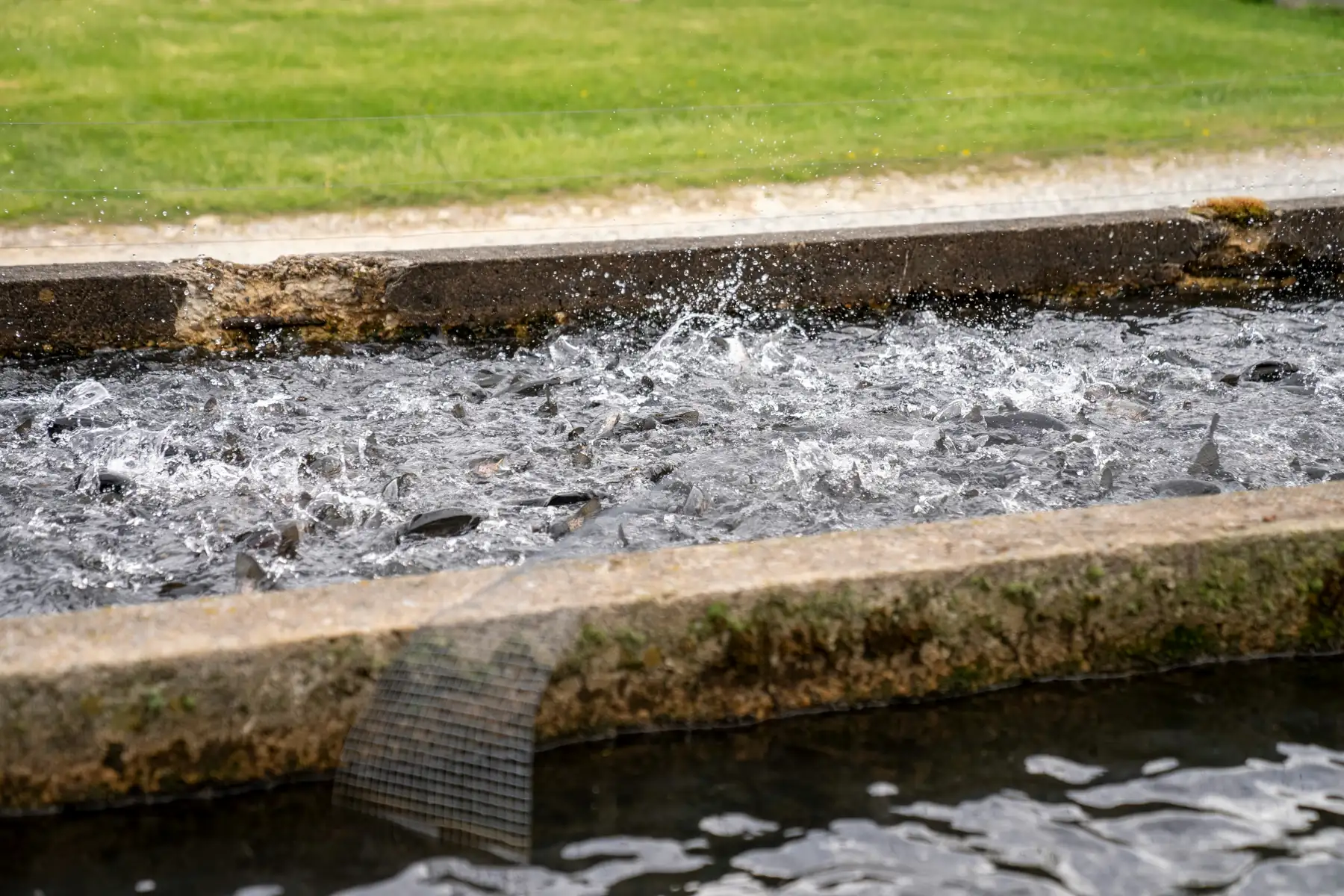
Turn fish behaviour into a control signal
The established surface scale describes a progression from normal swimming to an emergency:
| Level | Observable state | Operational interpretation |
|---|---|---|
| 1 | Slow, normal swimming; no dorsal fins or white sides at the surface | Target condition |
| 2 | Normal swimming near the suction point; a few dorsal fins; no white sides | Low stress, but monitor trends |
| 3 | Excited, disorganised swimming; more than 20 dorsal fins visible; some white sides continuously visible | Escalating welfare risk; intervene before conditions deteriorate further |
| 4 | Many fins and white sides; fish against the net; some lethargic fish; pumping rate cannot remain constant | High risk; conditions are unacceptable if they become more severe than level 3 |
| 5 | The whole crowd is “boiling” | Emergency with potential for a large fish kill unless fish are rapidly released |
The operational goal cited in the report is level 1, and crowding more severe than level 3 is considered unacceptable under the referenced welfare guidance. More importantly, the level is not merely something to record. It is a prompt to act.
During one commercial smolt transfer, the tank remained at level 1 for the first hour while water was drawn down. Intensity rose to level 2 when pumping began and to level 3 around 30 minutes later, as more fins became visible. Operators added water to the tank, reducing the observed intensity. This is monitoring closing the control loop: observe, intervene and verify the response.
The calm-surface problem
Surface observation remains valuable, but it can miss underwater hazards.
In a commercial net-pen crowd preceding delousing, the operation remained at level 2 for one hour and 20 minutes before rising to level 3. At times, visible activity at the surface was not matched by a dangerous underwater state. At other times, the surface appeared stable while fish below were touching the net and risked being pressed against it.
The project therefore recommends combining surface observations with underwater cameras or an ROV. Operators should look for:
- fish touching or being pressed against the net;
- folds or pockets that can trap fish;
- crowding close to equipment or the pumping area;
- gasping or other signs of respiratory distress;
- burrowing behaviour;
- loss of schooling structure, queueing or restricted movement;
- insufficient space between the fish group, the net and the surface.
The project’s preliminary underwater risk scale extends from no apparent crowding risk to catastrophic risk. Whether a farm adopts that scale or its own validated protocol, the lesson is the same: surface and subsurface observations must share one timeline.
Stress can rise before injuries become visible
Visible injuries did not always track the stress response during the trials. In the commercial cases, cortisol, lactate and glucose rose progressively during crowding even when injury scores showed few clear changes.
Skin integrity also deserves special attention before another handling step. In the commercial delousing crowd, scale samples from fish exposed for only seven minutes at level 2 showed migration in more than 70% of cultures after 96 hours. For fish sampled after one hour and 40 minutes, including 30 minutes at level 3, the proportion was only around 30%. The report interprets this as a possible sign of micro-damage that may reduce the skin’s healing capacity.
This does not establish a universal time threshold, but it supports two precautions:
- treat movement into level 3 as a meaningful escalation, not merely a change of label;
- protect fish from additional stress and skin damage after an intensive crowding event, especially when further handling follows immediately.
What a useful digital crowding record should capture
The report recommends a toolbox rather than a single indicator. A useful workflow in farm-management software should connect five layers of information. KAMAHU supports essential records—including stock tracking, movements between ponds, tanks or cages, site-to-site transfers, mortality, tracking sheets and production reports—and has developed dedicated AI models trained to detect signs of stress in fish cohorts. When connected to webcams, these models can identify abnormal behaviour in real time, helping farms build a consistent crowding workflow around the five layers below.
1. Pre-operation readiness
Record fish group, estimated biomass, mean weight, recent mortality, appetite, relevant health issues, previous treatments and visible injury levels. KAMAHU’s stock, weighing, mortality and veterinary-prescription records can bring much of this context together before the operation begins. Add equipment checks and define who can pause, dilute or release the crowd.
2. Environmental conditions
Log oxygen and other relevant water-quality measurements with timestamp, position and depth. An isolated reading is less useful than a trend that can be compared with behaviour and operational actions. Where farms use connected monitoring equipment, KAMAHU can couple with sensors so environmental measurements sit alongside farm records rather than in a separate data silo.
3. A live event timeline
Timestamp the start of water drawdown, net movement, pumping, treatment batches, interruptions and the end of the operation. Add the estimated density where it is available, while recognising that density does not replace direct observation. A configurable KAMAHU tracking sheet can give operators one shared format across sites and crews.
4. Surface and underwater welfare observations
Use a consistent intensity scale and record where each observation was made. Attach camera or ROV evidence when practical. The system should highlight worsening level, repeated white sides, gasping, burrowing, fish-net contact, net pockets or impaired swimming.
5. Actions and outcomes
Connect each warning to an operator response—adding water, slowing or pausing pumping, changing the net configuration, adding oxygen or releasing the crowd—and document whether conditions improved. Follow the event with mortality, appetite and injury observations so the team can compare immediate signals with later outcomes. KAMAHU’s traceability and reporting functions can then help managers review events across fish groups, sites and time periods.
Together, these layers turn welfare documentation into operational intelligence. Instead of asking only, “What density did we reach?”, managers can ask better questions:
- At what point did behaviour begin to deteriorate?
- Did the deterioration coincide with pumping, falling oxygen or a particular pen zone?
- Which intervention restored level 1 or level 2 conditions most quickly?
- Do certain fish groups, seasons, crews or equipment configurations produce more warnings?
- Did a high-risk observation predict later mortality, appetite loss or injury?
Because KAMAHU is customisable, farms can adapt the fields, reports and alerts to their own operating procedures. The aim is not to force every site into one rigid form; it is to give observations, decisions and outcomes a common structure that can be reviewed and improved.
Three rules for the next crowding operation
1. Keep the crowd steady, slow and controlled
The net-pen trials suggest that giving fish time to adapt, while monitoring the crowd continuously, can limit risk.
2. Treat intensity as dynamic
Density, duration, fish condition, water quality and equipment configuration interact. A fixed density limit cannot describe the whole risk.
3. Make every observation actionable
A welfare score that sits in a form after the event is documentation. A timestamped score linked to alerts, decisions and outcomes is management.
Crowding will always require experienced operators. Better data does not replace their judgement. It gives the team a shared picture, a common language and a record that can improve the next operation.
KAMAHU is designed to support that continuous-improvement loop through real-time monitoring, traceability, configurable reporting, alerts and data consolidation. Explore KAMAHU’s aquaculture management features or contact the team to discuss a crowding workflow tailored to your farm.
Paninnguaq Knudsen (September 2026)
Sources and editorial note
This article synthesises the April 2026 Nofima report Monitoring and optimising the crowding of Atlantic salmon using health and welfare indicators (CrowdMonitor) by Noble et al. The report describes both controlled experiments and a limited number of commercial observations. Figures should therefore be used as evidence from the reported conditions, not as universal operating limits. Farms should continue to follow applicable regulations, veterinary advice, welfare standards and site-specific procedures.
Further operational resources cited by the report: