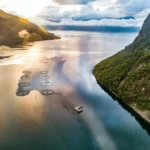
Sea cucumbers can consume and assimilate organic particles originating from salmon farms. The science behind that statement is credible. The harder question is whether they can intercept enough waste, reliably and economically, to become part of commercial salmon production.
The underlying idea is attractive: place an extractive species near a salmon farm, allow it to feed on material that would otherwise enter the surrounding environment, and produce an additional harvestable crop.
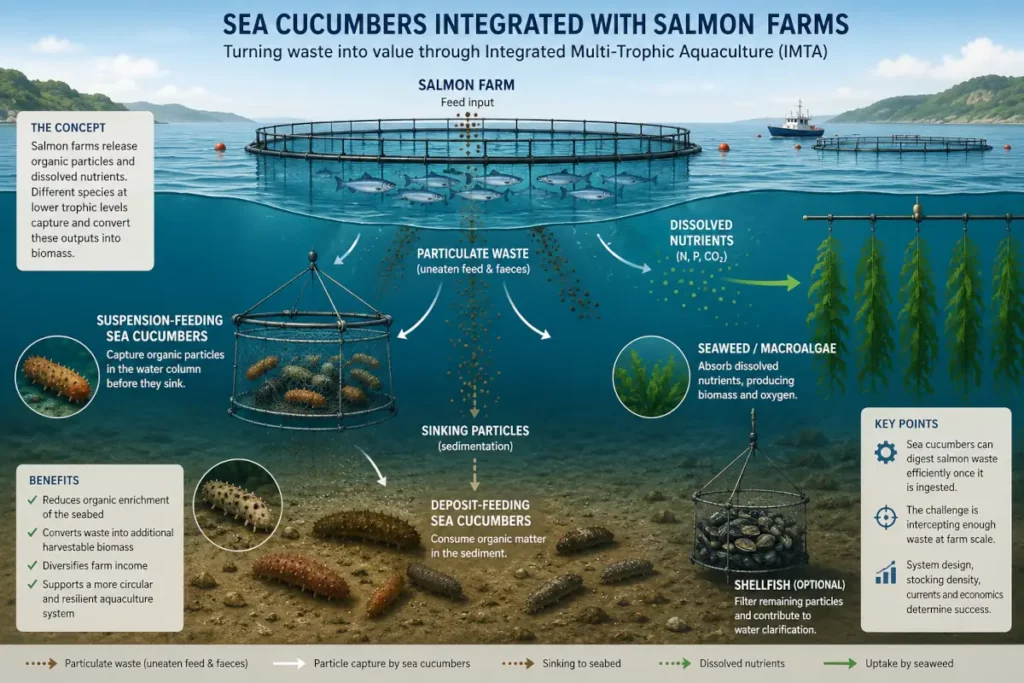
This approach is known as integrated multi-trophic aquaculture, or IMTA. Instead of treating each species as an isolated production unit, IMTA connects species occupying different nutritional levels. Wastes or by-products from one crop become potential inputs for another.
Sea cucumbers are particularly interesting because many species naturally consume suspended particles or organic material deposited on the seabed. Salmon farms release particulate matter in the form of faeces and uneaten feed, creating an apparent biological match.
But an apparent match is not yet an operating business model.
What did the 2012 study demonstrate?
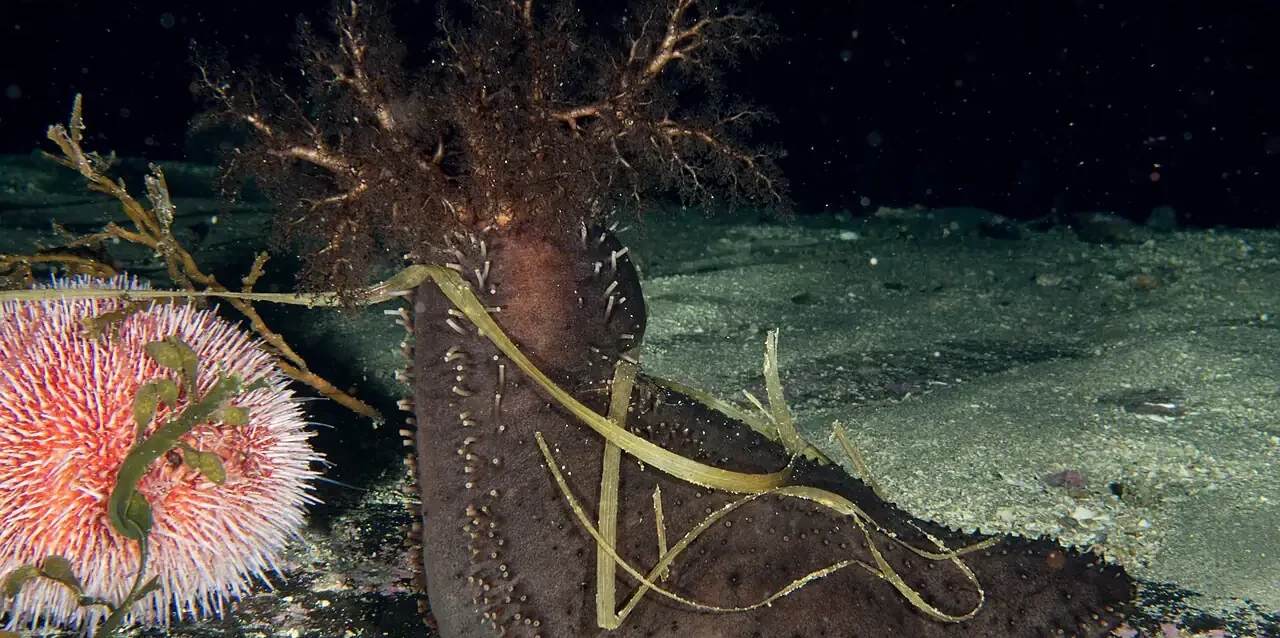
In 2012, researchers E. J. Nelson, B. A. MacDonald and S. M. C. Robinson published a study on the
orange-footed sea cucumber, Cucumaria frondosa.
The researchers measured how efficiently the animals absorbed organic material from different food sources. When exposed to particles with high organic content—including salmon feed and faeces—the sea cucumbers achieved absorption efficiencies above 80%.
In other words, once suitable salmon-derived particles entered the animals’ digestive systems, they were able to extract a substantial proportion of the organic matter.
That is important evidence. It shows that salmon-farm particles are not merely ingested and passed through unchanged. They can serve as a usable food source.
However, absorption efficiency is not the same thing as farm-wide waste-removal efficiency.
An animal might digest more than 80% of the organic matter it captures while capturing only a small fraction of everything released by the farm. The first figure describes digestion. The second depends on currents, particle settlement, animal density, farm design and many other operational factors.
Source: Nelson, MacDonald and Robinson, 2012, Aquaculture.
More recent trials remain encouraging
The concept has continued to attract research interest.
A Scottish feasibility project tested the native sea cucumber Holothuria forskali using a mixture of salmon faeces, uneaten feed and marine sediment. The animals survived the 58-day laboratory experiment while consuming the mixture.
Preliminary project estimates suggested that sea cucumbers might remove as much as 70% of waste within specifically targeted areas below aquaculture pens.
The qualification matters. This was not a finding that 70% of all waste produced by a salmon farm would automatically be removed. It referred to potential removal in areas where waste and sea cucumbers could be brought together effectively.
The project nevertheless points towards an important design principle: success may depend less on simply releasing animals under a farm and more on engineering a system that reliably directs particles towards them.
Source: Sustainable Aquaculture Innovation Centre—sea cucumbers as bioremediators for salmon farms.
Other research has also found changes in the composition of sea cucumbers raised alongside salmon, providing further evidence that salmon-derived material enters their tissues and contributes to their nutrition.
So why has the Norwegian salmon industry not adopted the
concept?
The absence of widespread commercial adoption does not necessarily mean that the biology failed. It reflects the distance between demonstrating a biological process and operating it at industrial scale.
1. The animals can only process waste they intercept
Open-net salmon farms operate in dynamic marine environments. Currents transport faeces and uneaten feed away from the cages, while particles of different sizes settle at different speeds.
A sea cucumber located below or beside a farm cannot consume material that passes outside its feeding zone.
This creates a fundamental distinction:
- Digestion efficiency: How much organic material is absorbed after a particle is eaten?
- Capture efficiency: How much of the farm’s total waste reaches and is eaten by the sea cucumbers?
- System efficiency: How much of the farm’s total environmental load is removed after accounting for the entire production system?
The 2012 study answered the first question positively. Commercial adoption requires convincing
answers to all three.
A later modelling and life-cycle study of an IMTA system found that sea cucumbers (Holothuria scabra) removed only around 0.73% of the fish farm’s solid waste under the stocking-density constraints examined. That study involved red drum (Sciaenops ocellatus) rather than Norwegian salmon, so the number should not be transferred directly to every salmon farm. It does, however, illustrate how a high ability to digest captured particles can coexist with low whole-system removal.
2. Commercial farms produce waste at a very large scale
A laboratory tank can maintain close contact between animals and a controlled food source. A commercial farm releases particles across a much larger and less predictable area.
Meaningful remediation could require:
- large populations of sea cucumbers;
- extensive seabed or suspended cultivation structures;
- systems for directing or collecting particles;
- regular monitoring;
- predator protection;
- and equipment for harvesting the secondary crop.
Each addition increases capital requirements, operational complexity and maintenance costs.
The central question for a farmer is therefore not simply, “Will the sea cucumbers eat the waste?” It is, “How many animals and how much infrastructure are needed to remove one ton of it?”
That question does not yet have a universal commercial answer.
3. Stocking density has biological limits
It may appear that low removal could be solved by adding more animals. In practice, sea cucumbers
cannot necessarily be stocked at arbitrarily high densities.
At excessive densities, individuals may compete for food, experience reduced growth or alter sediment
conditions. The appropriate carrying capacity depends on species, temperature, water movement,
oxygen availability, substrate and the spatial distribution of waste.
A remediation system must therefore balance two competing objectives:
- maintaining enough animals to process a meaningful quantity of material; and
- giving each animal sufficient space and food to remain healthy and commercially productive.
4. A suitable cold-water species must also be a viable crop
The 2012 study used Cucumaria frondosa, a cold-water species found in the North Atlantic. Its
environmental suitability is an advantage for northern aquaculture, but ecological compatibility is only
one part of commercial species selection.
A candidate must also offer:
- reliable hatchery reproduction;
- predictable juvenile supply;
- acceptable growth rates;
- manageable mortality;
- established processing methods;
- regulatory approval;
- and a market capable of paying for the final product.
Some of the world’s most valuable sea-cucumber species are associated with warmer waters. A species that performs well in Norwegian conditions may not command the same market price, while a high-value species may not be biologically appropriate for those waters.
Collecting large numbers of wild animals would not be (possible and) a satisfactory scaling strategy. Commercial adoption would require dependable hatchery production without creating additional pressure on natural populations.
5. The business case remains uncertain
IMTA is often described as turning waste into value, but the value does not appear automatically.
A sea-cucumber crop creates additional costs for juveniles, equipment, labour, monitoring, harvesting, processing, certification and sales. Those costs must be covered by some combination of:
- sea-cucumber revenue,
- improved farm performance,
- reduced environmental-monitoring or remediation costs,
- additional production permissions,
- market premiums,
- or regulatory incentives.
Without one or more of those benefits, the salmon producer bears the cost of the environmental service while its financial return remains uncertain.
European IMTA programmes have repeatedly identified economics, market development, regulation and operational complexity as major obstacles—not only the underlying biology.
Source: EU IDREEM project: Increasing Industrial Resource Efficiency in European Mariculture.
6. Existing farms were not designed as multi-species systems
Adding sea cucumbers is not as simple as attaching one more cage.
The system may need to accommodate different production cycles, husbandry protocols, equipment, veterinary considerations and harvesting procedures. The most suitable location for growing salmon may not be the best location for sea cucumbers.
Responsibility must also be clear. Who owns the secondary crop? Who monitors it? What happens if disease, mortality or an escape occurs? How should environmental performance be measured?
Aquaculture regulations and licences have traditionally been organised around individual species and defined production sites. A multi-species farm can therefore encounter administrative requirements that were not designed with nutrient recycling in mind.
A 2022 systematic review and industry survey found that commercial IMTA implementation on Atlantic salmon farms is limited by uncertain mitigation performance at scale, the cost and complexity of cultivating extractive species, insufficient commercial demonstration, and limited institutional support.
7. Sea cucumbers address only one part of salmon farming’s
footprint
Sea cucumbers could potentially intercept particulate organic material. They do not provide a complete environmental solution.
They do not directly prevent:
- salmon lice;
- fish escapes;
- disease transmission;
- fish mortality;
- or all dissolved nutrient emissions.
Different extractive organisms perform different functions. Seaweeds, for example, can take up dissolved inorganic nutrients, while shellfish may capture suspended particles. Deposit-feeding sea cucumbers can act on material reaching the seabed, and suspension-feeding species can intercept particles in the water.
A serious IMTA strategy may therefore require several complementary species rather than treating sea cucumbers as a stand-alone remedy.
Norway’s Institute of Marine Research identifies salmon lice and escaped farmed fish among the major environmental challenges associated with salmon farming. It is understandable that considerable investment and regulatory attention have consequently gone towards lice control, containment, welfare and escape prevention.
Source: Norwegian Institute of Marine Research—Environmental impacts of aquaculture.
A promising organism in search of the right system
The evidence supports a balanced conclusion.
Sea cucumbers can consume salmon-derived organic matter. They may also convert part of that material into a saleable product while contributing to sediment processing and nutrient cycling.
What has not yet been demonstrated consistently is a commercially attractive method that:
- intercepts a substantial share of farm waste;
- maintains healthy sea cucumbers at appropriate densities;
- works under variable farm and current conditions;
- produces a marketable secondary crop;
- satisfies regulatory requirements;
- and delivers a measurable net environmental benefit.
This is not a reason to abandon the concept. It is a reason to focus research on system design and commercial validation rather than repeating proof that sea cucumbers can eat fish-farm particles.
What would make adoption more likely?
For aquafarmers, the most valuable next-stage trials would report results in operational terms:
- kilograms of salmon waste removed per square meter;
- percentage of total farm particulate output intercepted;
- sea-cucumber growth and survival over complete production cycles;
- labour and infrastructure costs;
- harvest value;
- performance under different current and seabed conditions;
- and environmental outcomes compared with an equivalent salmon farm without sea cucumbers.
It would also be useful to compare several configurations: animals directly on the seabed, animals in trays or cages, and systems that first collect or concentrate solids.
The most compelling commercial model may eventually combine biological extraction with physical waste capture. Concentrating particles before feeding them to sea cucumbers could make the food supply more predictable and reduce the main limitation of open-water systems: contact between waste and the extractive crop.
From proof of concept to practical aquaculture
Sea cucumbers offer a powerful image of circular aquaculture: nutrients that would otherwise be dispersed are captured and transformed into biomass.
The image is supported by real biology—but commercial reality demands more.
The key question is no longer whether a sea cucumber can digest salmon waste. Research has shown that it can. The key question is whether farms can deliver that waste to enough sea cucumbers, at an acceptable cost, while producing measurable environmental benefits and a marketable crop.
That remains an open engineering, biological and economic challenge.
For the salmon industry, the appropriate position is neither uncritical enthusiasm nor dismissal. Sea-cucumber IMTA deserves continued testing, particularly in systems designed from the outset to collect and redirect solids. At the same time, claims about waste removal should always distinguish between what an individual animal digests and what an entire farm actually prevents from entering the environment.
Paninnguaq Knudsen (July 2026)
Turn Aquaculture Data into Better Decisions
Innovations such as Integrated Multi-Trophic Aquaculture show how better system design, monitoring and operational data can help fish farms improve resource efficiency and environmental performance. KAMAHU’s fish farm management software enables aquaculture producers to monitor production, feeding, biomass, mortality, traceability and farm performance in real time – helping teams develop more efficient, sustainable and profitable aquaculture operations. Discover KAMAHU’s aquaculture farm management system and request a demonstration to see how digital farm monitoring can support your business.
References and further reading
- Nelson, E. J., MacDonald, B. A. and Robinson, S. M. C. (2012). The absorption efficiency of the suspension-feeding sea cucumber, Cucumaria frondosa, and its potential as an extractive IMTA species.
- Chary et al. (2020), Integrated multi-trophic aquaculture of red drum (Sciaenops ocellatus) and sea cucumber (Holothuria scabra): Assessing bioremediation and life-cycle impacts
- Sustainable Aquaculture Innovation Centre: Investigating sea cucumbers as bioremediators for salmon farms.
- Sickander, O. and Filgueira, R. (2022). Factors affecting IMTA (integrated multi-trophic aquaculture) implementation on Atlantic Salmon (Salmo salar) farms. Aquaculture, 561, 738716.
- European Commission: IDREEM (Increasing Industrial Resource Efficiency in European Mariculture).
- Norwegian Institute of Marine Research: Environmental impacts of aquaculture.
- Sunde J., Christophersen G. (2022). HOLOSUSTAIN workshop. Aquaculture prospects for North Atlantic sea cucumber species.